
News and commentary about the real estate market and related topics. The opinions expressed here are my own and don’t necessarily represent those of REMAX International.
Dave Parrish, ABR®, CRS®, CSP, GRI, ePRO®, REALTOR®, REMAX MarketPlace
Dave Parrish, ABR®, CRS®, CSP, GRI, ePRO®, REALTOR®, REMAX MarketPlace
Current Birmingham Metro Real Estate Market and the likely future trends…
When making a decision to buy or sell in the current environment, it is essential that each person be aware of not only the current market and what is likely to happen in the months to come. The information presented here is based on the general real estate market in the metro Birmingham Area, which includes, Jefferson, Shelby, St Clair, Talladega & Blount counties. It is important to note that this market area is comprised of literally thousands of micro markets. Each micro market area is influenced by the factors discussed here but not necessarily in an even way. So for a more detailed view of the micro market of greatest concern to you, we would need to begin with the exact location that you are interested.
With that in mind, lets begin with the current status of the market in the 5 county market area of the Birmingham Metro Area. Since at least mid 2018, we have had an increasingly low inventory of single-family homes for sale in this market. Currently (May 10, 2020), there are 3,797 Single Family homes for sale (not under contract) for sale in our market. The current average number of Single Family homes sold per month during the last six month sales is: 1412. With an inventory of 3,797 Single Family homes for sale there is only a 2.7 months inventory of homes for sale based on the current sales rate. This is a very HOT Market (Seller driven) especially for homes priced below $250,000 (the upward boundary for starter homes).
On the home building front most of the major builders have pulled their horns in substantially. Inventory will continue to be a problem for the near-term foreseeable future.
This is an extremely competitive market and is advantageous to the seller. Sometimes, homes will sell as soon as they are listed. Typically, during a hot market, multiple offers will be made on a home and more often than not, homes will sell for more than the asking price if priced appropriately. In a normal or balanced market will have between a 5-9 month window of real estate inventory. What this means is that if no other home ever came on the market, all the current homes on the market would sell within 5-9 months in a healthy/balanced market.
This truly reflects what we are experiencing in the market, almost any home in a desirable location in decent condition will go under contract within 15 days and multiple offers are highly common. Many homes are selling above list price with fewer concessions made by Sellers than has been typical for the past 10 years.
This obviously creates a tough market for Buyers. But before Sellers celebrate too much, the are a few caveats. As a seller, will you need to become a buyer simultaneously? What does the market look like for the home that you are buying, location, price range, and amenities. Understand well the market that you will be facing. I remember selling a home about 35 years ago and the stress of not being able to find a suitable home after going under contract for the home sold. We finally had to rent while we built. It is important to work out your full plan before proceeding.
But that’s not the only concern. There is a big question about how long this Seller’s Market is going to last especially in light of the COVID-19 Crisis. What will the new normal be? What are the impacts of likely changes. Now before delving into this prognostication endeavor, let me be clear that I am not saying that this is definitely what is going to happen. I feel anyone who is certain about what the new normal will be or that space between now and then should not be relied on.
That said, I do believe we should consider what we know to be true thus far and to logically think forward as to what could happen following some likely outcomes. You may disagree with my logic and if you’ve considered these factors and feel that I am being overly pessimistic or perhaps optimistic that’s fine. I just want you to consider these possibilities before proceeding with your decision-making.
At this date, we’ve just received word that the national unemployment rate is 14.7%, which excludes some ineligible folks as well as those who have given up on looking for employment. This is up from a recent 50-year record low unemployment number of 3.7% less than 90 days ago. Conservative estimates are that the real unemployment rate falls some were between 20-25%. (Fortune on 5/7/2020: Real unemployment rate soars past 24.9%—and the U.S. has now lost 33.5 million jobs).
What really matters of course in real estate is what is the local unemployment rate. Alabama’s March Unemployment rate was a low/healthy/favorable 3.5% and the Birmingham Unemployment rate for March a low of 3.0%. Typically Alabama has an unemployment rate of 7-10%, so we were definitely experiencing a boom. The question is what is likely to be the unemployment rate as we exit the COVID-19 Crisis.
At this point I have not been able to locate any solid data for more recent numbers than March (post the Stay at Home period which began mid March). There can be little doubt that we will experience much higher numbers, as we move into and through summer, with some relief based on the ability to reduce COVID cases. At this point Alabama COVID Cases are still on the rise. That said, we are still likely to fare better than the rest of the nation but how much better is yet to be determined.
The market and here I’m referring not to the real estate market but the larger economic market and primarily the retail market that includes a wide array of business including, food service, entertainment, retail merchandise industries seem to be undergoing some accelerated adjustments: J Crew, Macy’s, J C Penny, Nordstrom just to name a few in the department store arena and accompanied by lesser known players in other spaces. All of which are not much more than early implementation of the well expected shrinking of brick and mortar venues exacerbated by the pandemic. All rethinking their long term future and manpower requirements. In short, while the list of players impacting the Birmingham market may be different, lots of jobs are not coming back.
It’s a well-published fact/assumption that most American families do not have ample savings to weather a financial storm. Last May, it was reported (CNBC: May 23, 2019) that nearly a third of families cannot weather a $400 financial crisis. How bad has that number grown during the COVID-19 crisis? It has certainly worsened and as a result, even though there are some efforts at forbearance to protect families from evictions and foreclosures, we will certainly see a reduction of Buyers that can qualify for a mortgage and over a longer period of time an increase in foreclosures.
I’m a logical animal. I don’t see how this doesn’t impact the real estate market. My forecast is that we will see a significant softening of buyer demand in the next 90-120 days. With mortgage acceleration (the first steps of foreclosure) increasing dramatically in the same time period. However, we will not see those homes appearing on the market until next spring (2021). Creating new opportunity for investors and the fortunate homebuyers that can remain unscathed by the pandemic. I don’t believe the impact will be as deep as the 2008-2010 period but I also don’t think recovery is likely to be as quick.
The latest news on COVID-19 in Alabama (5/10/2020): Alabama on Sunday (5/10/2020) had more than 9,600 confirmed cases of COVID-19 and was approaching 400 deaths from the illness.
State Health Officer Scott Harris said Friday that caseloads have been “a little higher” in recent days, but officials are trying to determine how much of the change was linked to increased testing or increased disease.
Virus cases have risen by 2,000 since the state loosened some restrictions 10 days ago, lifting a stay-home order and allowing retail stores to open with occupancy limits.
More than 450,000 Alabamians have applied for unemployment since the pandemic began. That’s 10% of Alabama’s population of 4,908,621.
Sellers’ DO NOT miss the Seller’s Market while it lasts. Buyers beware of a market to likely change.
This is real folks. Stay safe.
May the market be with you.
Dave Parrish, ABR ®,CRS,CSP,GRI,ePRO ®, REALTOR ®
RE/MAX MarketPlace
Making a difference!
Going a bit deeper into the numbers
*The highest rate of U.S. unemployment was 24.9% in 1933, during the Great Depression.1_ Unemployment remained above 14% from 1931 to 1940. It remained in the single digits until September 1982 when it reached 10.1%.2_ During the Great Recession, unemployment reached 10% in October 2009.
The government steps in when unemployment exceeds 6%. The Federal Reserve uses expansionary monetary policy to lower interest rates.3_ Congress uses fiscal policy to create jobs and provide extended unemployment benefits.
The unemployment rate falls during the expansion phase of the business cycle. The lowest unemployment rate was 1.2% in 1944.
A break down for the full real estate market for the Birmingham MLS based on data available at this point in time (May 10, 2020):
4183 total homes for sale includes Single, Family, Townhomes, Condos and Manufactured Homes and Farms:
3,797 Single family
76 Town homes
154 Condos
130 Manufactured Homes
26 Farms
Total Sold between 11/01.2019 and 04/30/2020:
9291 All Classes = 1549 per month
8469 Single Family = 1412 per month
331 Town homes = 55 per month
308 Condos = 51 per month
158 Manufactured Homes = 26 per month
25 Farms = 4 per month
Months of Inventory Currently Available based on past 6 months of sales
9291/1549 Overall Market All Classes combines = 2.7 Months Inventory
3,797/1412 Single family = 2.7 Months Inventory
76/55 Town homes = 1.4 Months Inventory
154/51 Condos = 3.0 Months Inventory
130/158 Manufactured Homes = 0.8 Months Inventory
26/25 Farms = 1 Months Inventory
A typical healthy balanced market will have between a 5-9 month window of real estate inventory. What this means is that if no other home ever came on the market, all the current homes on the market would sell within 5-9 months in a healthy/balanced market.
This is an extremely competitive market and is advantageous to the seller. Sometimes, homes will sell as soon as they are listed if priced appropriately. Typically, during a hot market, multiple offers will be made on a home and more often than not, homes will sell for more than the asking price.
… Hope dies last, You can’t lose hope. If you lose hope, you lose everything.
– Jessie de la Cruz
So here we are in that period at the end of the year between the celebrations of Christmas and the New Year… A time when many, if not most, accept that there is little that will get done… A time reserved for reflection and perhaps planning… the making of resolutions and promises… a time of hope. Hope that what we have learned can be used to make for a better new year… improvement in not only material outcomes but also in our experience of what is to come.
An often belittled, if not ill-regarded force, hope is nonetheless a powerful force… perhaps the most powerful of forces. But its power is found only when properly harnessed. So how does one harness that power? How do you harness hope?
Experience has taught me that hope can be best harnessed when we do the following:
Accept that all things are temporary. Develop a vision of the possible future, knowing that we are not bound to the past or for that matter the present… Never giving up… Persisting… Setting achievable next steps toward incremental goals. Daring to dream again aware that obstacles will surely occur. Overcoming disappointment, disillusion and circumstance. Remembering always that all things are temporary.
Twenty years or so ago, I worked as a volunteer telephone counselor at the Birmingham Crisis Center. Here we encountered many types of calls… people reaching out in a moment of need or anguish… frequently in moments of hopelessness. First and foremost, my job was to listen… to allow the caller to be fully heard.
On occasion, those moments of hopelessness were extreme… the caller being unable to see a way forward. As irritating as it may sound, my responsibility … my “job” if you will… was not to solve the caller’s problem but to help the caller to develop hope in a better future and to aid the caller in deciding on what they might do next to move things in a different direction.
This was most frequently accomplished by asking the questions: What would make your situation better? What would you like to change? Then working with the caller to develop a simple to do list of things that they would/could commit to toward that end with the promise that they would check back in with us as needed to work through the obstacles that were sure to arise as they moved forward.
I am no longer a telephone counselor but a Realtor… a real estate advisor/counselor. My job remains largely to listen, to help my clients move forward… step by step toward their goals… their dreams… their hopes… Hope is a powerful thing.
An integral part of our human nature… Hope is the defining characteristic of the optimist. But even the pessimist hangs on to it, for to be hopeless is to lose everything. My hope for us all is that we will use this week as a pause to reflect on what we want to change and our next steps in making that or those things happen.
May the market be with you… and may your New Year be all that you hope for.
It was easily more than fifty years ago that I first heard the questions: What, Where, When, Who, How, Why… presented as the questions to be asked when trying to understand the truth of a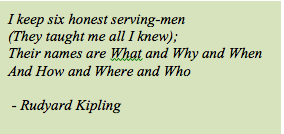 situation… the questions to get answered when gathering the facts… the questions that must be understood to solve a problem. Those questions and the process of using them to understand more deeply have been with us for millennia. Philosophers and scientists both base all of their work on the structure provided by these questions.
At least a portion of the power of these questions comes form the fact that they are open-ended questions… questions than cannot be answered yes or no… questions that require a revelation of something deeper. While each question plays a vital role in the process of understanding, there is one question that provides a very different type of insight… an insight into motivation. The questions: What, When, Where, Who and How are questions that for the most part that are answered with provable facts. But the question “why” is a different story and frequently the real story.
So how does this relate to real estate? Understanding my client’s story: their obvious and immediate needs can largely be understood with those first five questions. But in each case… with each question there is the follow-up question of “Why.” Why is that important?
Knowing why something is important at the deepest levels informs us of the deeper goals… the real motivation and the real target for each client… each buyer or seller. Looking for a real pro? Look for the agent that wants to know more… the agent that understands it’s about more than the number of bedrooms and bathrooms… more than just location… an agent that demonstrates an interest in meeting real needs and desires at the deepest levels. It’s not empty curiosity. It’s what the professional advisor should know to serve their clients fully.
May the market be with you.
I do want to make it clear from the outset that I not only understand but very much appreciate the difficulty in finding the right home. At the same time, I know that no home is perfect. There are so many factors to consider: location, school zone, neighborhood, neighbors… are chief among those critical factors that really must be met, as they are difficult if not impossible to change. Overlooking any of these items is a recipe for disaster… my description of a buyer that becomes unhappy with their decision after completing the purchase.
If I’ve learned anything in my years as a real estate advisor and counselor, it’s that everything that goes wrong with a transaction will ultimately be seen as my fault. So, I frequently remind my buyer clients about the future potential of a property to meet their long-term and short-term needs. I am dedicated to that principle.
That said, there are other factors about a home that can be changed. My job is to advise my clients about the possibilities that they may be unaware of… to help them consider how we might address the issues that cause them to say: “I really like this house, but…”
Now those objections can be of all types and levels of severity. I’ve heard buyers say: “I like this house but I can’t stand those green velvet drapes or that red couch!!” I understand… everybody’s taste is different… But the red couch is not staying; it’s going with the Seller to their new home. And, we can take down those green velvet drapes and replace them with something more to your taste. What would you rather see covering those windows, if this was your home?
Of course other objections may be more consequential. For example, a recent client was really concerned over the thirty-one year old AC. Certainly an understandable concern. Was that a showstopper? I negotiated its replacement and few other repairs as well.
But not every issue can be negotiated in this manner (where the Seller takes care of the issue). There are those foreclosed properties, short sales and other properties being sold-as-is where the seller will really do nothing other than perhaps address a few lender required repairs. What about those properties that if it weren’t for this or that issue or perhaps a much longer list of issues would really meet the buyers’ needs and desires. There is yet another possibility: A Renovation Loan.
So what is a renovation loan? While called by different names, such as 203(k) the FHA Renovation Loan or HomeStyle (the FannieMae Renovation Loan), both are mortgage products offered by many but not all lenders that provide homeowners the ability to obtain funds to renovate a property. These loans are available to both prospective purchasers, as their home purchase mortgage, and to existing homeowners through the re-finance process.
Make no mistake about it, there are additional rules and requirements associated with renovation loans but they are worth strong consideration for those homes where you may be saying “I like this home, but…” Ask your Realtor ® to explain the option in more detail to see if this is a tool that helps you make that home work for you and your family. After all that’s our job… to help you solve problems.
May the market be with you…. And may all of your dreams be realized.
Summer… a time for resting, relaxing and rejuvenation. And so I find myself today at the beach in a place called Panacea… a small village on “the forgotten coast.” The weather  forecast for our stay: rain every day… not considered good news for a beach trip. Between showers, during a late afternoon walk on the sparsely populated beach the day after our arrival, my wife and I encounter other souls on this thinly populated piece of paradise.
We speak with a couple that it turns out are natives. We ask questions about the quality of the surf, the alligators and snakes visible in the brackish water of the canal adjacent to the beach house we are staying. We were told that the gators rarely travel further in the surf than the point at which we met, about 400 yards west of where we are staying and then only in times of flooding like this week… the snakes, well while present, are not an overwhelming presence and for the most part non-venomous.
And so it is … A problem or two even in paradise. Ironic to encounter this in a place called Panacea. But how typical of real life. Nothing is perfect unless we deem it so.
Ah, but at last we are away from the hustle and bustle of everyday life. In a place, for the most part, that time has forgotten… a place rich with wildlife diversity of the natural sort… Making the best of the situation, we enjoy the amazing variety of shore birds, whole live muscles the size of your palm plentiful enough to lure you into the thought of collecting for a meal, once again experiencing an abundance of fish and crabs, which have become all too uncommon on the popular beaches further to the west… No condos…The Florida of my youth… a place to which others have attached the name: Panacea.
I reflect on the name of the place we have landed: Panacea a solution or remedy for all difficulties or diseases… Panacea a word describing something that will make everything about a situation better… a cure all.
This gets me to thinking… My job as a Realtor, often has me chasing perfection. It has me working long hours: 10-12 a day, pretty close to 7 days a week. From a distance it looks easy. But then what doesn’t look easy from afar. I’m not complaining… Just reflecting… Salt air, ocean breezes, crashing waves and gull songs make me pensive.
There are no perfect solutions. No cure alls… No panaceas. But that does not mean that we must remain captives of the perfection pursuit… rejecters of the incremental progress toward improvement. The real estate market is but one example. While so much better than a few years ago and ever improving, there is always the next problem the next reason to complain or become anxious. We are always faced with problems: too much inventory, too little inventory, high interest rates, tight credit, loose credit, rising prices, falling prices, static prices… and even when those rare moments of balance occur, we miss them waiting or looking for something better. How many clients have missed good deals in search of the illusive ideal deal.
Experience has taught me that the winners are those who actually take action. Those who see the possibility in what others find fault. With that thought, I’ll head back to the beach holding my wife’s hand on this our last day before heading home… glad to have seen a glimpse of paradise, imperfect as it is.
May the Market be with you…
Summer has arrived and that great American Holiday… July 4th is upon us… a time to celebrate!
Despite the rhetoric of this highly political season, there is much to celebrate. To be sure there are troubles in this land of ours, as there is throughout the world. We can be equally sure that we do not and will not all agree on all the problems facing our union let alone the best solutions to those problems. Our sacred freedom of speech allows us to voice our opinions, hopes and dreams… it is for this and our other freedoms that my fellow Marines and I have served.
We as a nation have oft been referred to as A City on a hill … a beacon of hope to the peoples of the world… a land where dreams may be not only dreamt but also fulfilled. I do not cheapen those possibilities when I speak of the American Dream.
So what is this American Dream? As I see it, the American Dream has as its central tenets: (1) personal liberty, bounded only by the protection required to keep those liberties from infringing upon the rights of others; (2) the opportunity through the efforts of one’s own capabilities to be what one can be, to build a future.
For most Americans, a primary fruit of the American Dream is home ownership… a place to call home… a place where we can exercise some degree of control over what colors the walls are and where we raise our children. For those of us who were fortunate enough to have always had a home and a place to exercise our freedom of expression, this may sound trivial. It is not.
Home ownership is a model for citizenship. It is a privilege; yet, it is something earned. It bears with it a responsibility… a responsibility of care and continued effort less it fall into disarray… also the responsibility to be a good neighbor… We rise and fall with our neighbors… no man is an island unto himself.
Collectively, we are all better off the greater this model of citizenship and involvement in homeownership is responsibly experienced and lived out. Just as with citizenship, we are all stronger when all participate. I celebrate citizenship, responsibility and the American Dream.
May the Market be with you… May your dreams be fulfilled… Celebrate your possibilities.
Rarely a day goes by without my hearing the question: “How’s the market?” Those of you who have been reading The Real Story since 2008 or even for just the last year or two or have personally asked me that question during the last 10 years know that my response is always the question: “That depends on where you live, where do you live?”
Sure enough, it does depend on where you live, the market you are talking about or interested in. The metro Birmingham (Jefferson, Shelby, St Clair, Talladega & Blount counties) market is comprised of literally thousands of micro markets each with its own unique conditions and considerations. Your perspective: buyer or seller, long term, short-term, also makes a difference in a useful answer to the question: How’s the market?
A response of GREAT! Really doesn’t tell you a darn thing. But them quoting statistics ad nauseam from some invisible teleprompter isn’t a lot more useful either. You need real information… interpreted and translated to useful information! Useful information being the important goal.
So it is that when I answer questions about the market, I am most often focused on what the listener is most concerned about and am thus focused on information about a very specific micro market. However, as is often the case, there is an exception to every rule or good practice.
WARNING: Following is some general information about the entire Metro Birmingham Market. It is useful in that it talks about the general trends in the overall subject market… the current trajectory of the market. However, it alone is insufficient for making decisions on buying or selling real estate. Finding exceptions to these trends is exceptionally easy. Nonetheless, you should find this information useful – sometimes comforting, sometimes challenging. But, nonetheless useful.
Remember this is general information… high-level bullet points:
• The Great Recession (for real estate) is over!
• First-Time Home Buyer Programs (read: tax credits, lenient terms, etc) have all but disappeared.
• Property values are again appreciating… median appreciation rate is in the 3-4% per year rate.
• Inventory of available homes is low… It is increasingly difficult to find a home quickly.
• It is no longer a Buyer’s Market… We are experiencing a moderately strong Seller’s Market… conditions are favoring the Seller.
• Multiple offers are common – often resulting in calls for Buyers to provide their Highest and Best Offer! It is not unusual for buyers to loose out on that perfect house and have to begin the search process again.
• Foreclosures are definitely on the decline. They have rarely been the best buys on the market.
• Investors are having to compete for homes in “good” markets!
• Many distressed markets are becoming re-vitalized.
• What Buyers want is changing… millennials (representing the largest group of home buyers) have a totally different view of the ideal home. This will impact the future value of your home.
• The day of the McMansion is coming to a close.
• Low interest rates continue… but expect them to begin to rise soon. The Federal Reserve has made it known that they will rise as a response to inflation… soon.
• New Home Construction has resumed… but at an insufficient level to meet demand.
• Buildable lot inventory is close to an all-time low.
• Cost of new construction is rising at a rate higher than inflation or appreciation.
• As has historically been the case, existing homes offer a far superior deal per square foot than new construction.
• Inflation and anticipated interest rate increases are reducing the buying power of most buyers… the amount of home that a buyer can afford today is greater than it will very likely be next year.
• Now is a GREAT Time to Sell!
• Yes, Now is also a Great Time to Buy!
Before acting on any of this information about the Changed Market, you need the help of an experienced real estate professional capable of answering that important question for you!
May the Market be with you.
When I was child, I’d go to work downtown with my father on Saturday mornings probably once or twice a month… He worked in the John Hand Building on what was billed as the heaviest corner on the earth. It was a real treat! Once a month, I would take the street car (those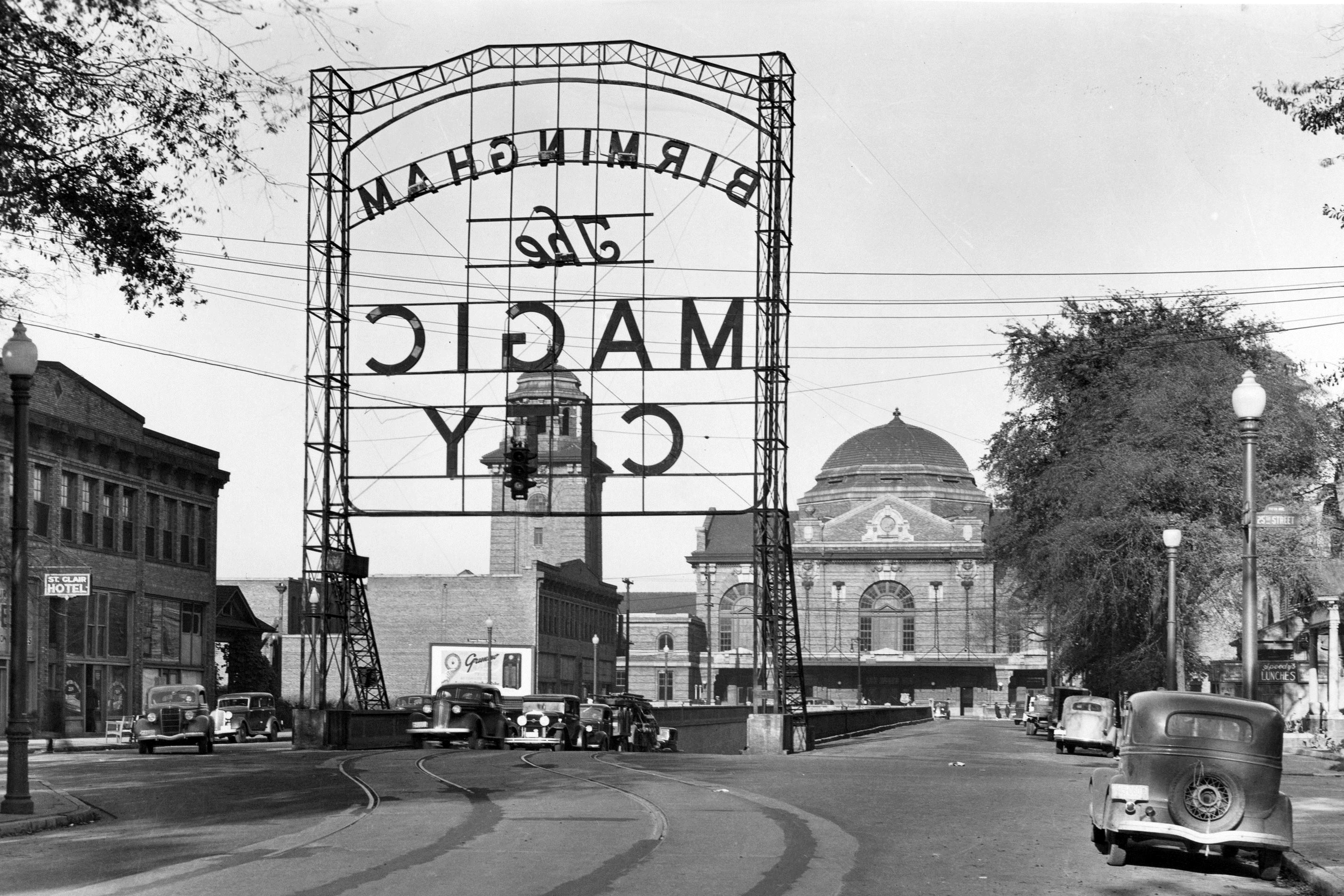 same street cars that now run on St Charles Ave through the Garden District in New Orleans) from the end of the line near the Roebuck Golf Course right in front of the Chateau just east of Lou Jac’s with my grandmother to have lunch at Britling’s and see a movie at one of the downtown movie houses: The Alabama, The Lyric or the Melba… This was the 50’s … the early 50’s at that… in a time when Birmingham was still known as the Magic City.
As the returning vets from World War II and the Korean War began buying homes in the suburbs for a little space and some fresh air, Birmingham continued to grow and thrive… but absent the PR push of it’s sister city Atlanta it began to loose a bit of its magic. In 1950 Birmingham’s population was only 15,277 less than that of Atlanta. The magic died in the 60’s with our national infamy and unrest. Though voted an All American City in 1970 with much energy and investment made to renew the city through operations like “Birmingham Green,” my hometown continued its decline for decades. You don’t have to be a native to know the history and reputation.
During the more than 42 years that lapsed between Birmingham’s first and second recognition in 2013, as an All American City, there had been many attempts to resurrect this once bold city on the move… to breathe life back into the giant of Alabama cities. So much hope placed in the recognition of UAB as an emerging medical leader, or commercial redevelopments of Morris Avenue, multiple iterations of 5 Points South, the building of the BJCC in hopes of re-uniting the city with it’s northern neighborhoods … all with little impact against the forces of history, the stigma of the past, the migration of its citizenry to the surrounding townships creating a wall of containment to the once great and magic city.
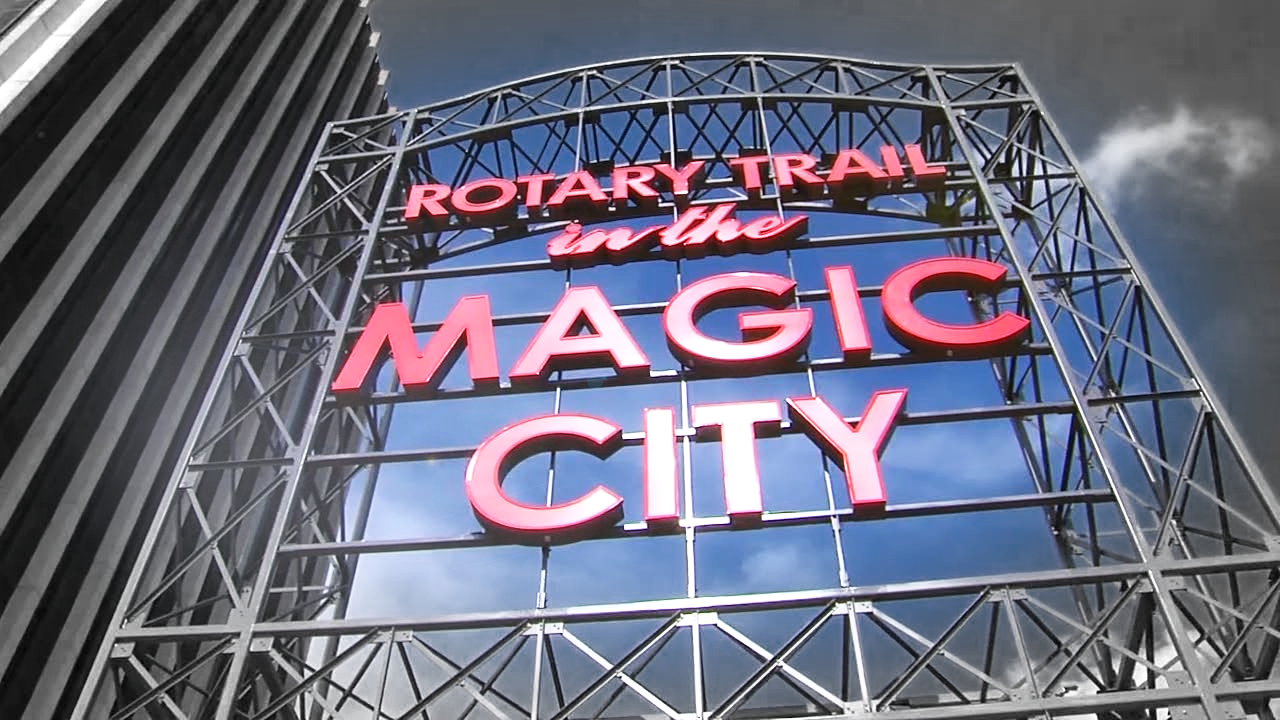 However, if you’ve been downtown lately you’ve no doubt heard the reverberating din of activity and seen the noticeable signs of rebirth or perhaps experienced the treat that downtown has become. Once thought of as a wasteland or the southern version of the rust belt… viewed as doomed… seen by many as a city destined for ruin or at best a hopeless existence, Birmingham is once again a special place. I could go one with adjective and verse describing the enthusiasm I feel about the re-birth of this city… but that is not my purpose. Instead I wish to look at the why.
Who are those responsible for what we see today?
While no doubt some credit could be given to corporate entities now non-existent and perhaps even to politicians… some of whom have fallen into disrepute but who nonetheless refused to quit on the possibility that the Magic City had life yet experienced. There were committees and action groups endless performing CPR on her. There were institutions that gave us something to be proud of and thus kept hope alive. All were contributors to what is today. But the energy that drives what is today comes not from those traditionally viewed as powerful influencers, as much as it does from those that collectively saw the possibility of Birmingham as a place to live and play… largely to that oft maligned group called the “Millennials.”
The “Millennials” … those born between 1982 and 2004, the older of which are now coming of age and into the position of influence have demonstrated a desire for a different kind of life … a more livable life style. Not afraid of but embracing diversity, they seem to look for a place where living and playing all happen within their reach… without the need to traverse chaotic travel corridors, places where there are sidewalks, local pubs and eateries they can walk or bicycle to… for the most part disdainers of chains… lovers of the unique and perhaps freaky … the live and let live generation have found beauty in this old town now better than new… Yes, a town with a not so beautiful past but reborn in hope, recycled and re-tooled.
While still constrained by the forces of history, politics and decades of decline, Birmingham once again has more than a twinkle in its eye, or a spring in its step and hopes for a brighter future… It seems the magic is back. And the source of that magic is likely to make more changes that to many will defy what we may have believed possible… Those changes may soon be coming to a neighborhood near you. They are after all the folks who may well decide what the future value of your home shall be. Pay attention.
May the Market be with you.
Here we are the week before Christmas, like me you may be nowhere near what you deem ready for a day full of anticipation and expectation. As that clock ticks frantically down, I invite you take a moment away from the rush…. a moment to reflect… a moment to center your thoughts… a moment to make Christmas happen within you first.
Here’s a how to do that idea… not complicated but one I’ve found that seems to work, at least for me. Take a word… not just any word but one that reflects on a value of consequence… an ideal… a goal. The two words that have worked best for me in the past: Peace or Love.
Now I ask you to give to yourself the gift of five-to-ten minutes. Does that seem impossible? I hope not. If so, remember you have that drive to work, or maybe during the day while performing mind-numbing tasks.
Hopefully, you have a quiet place to which you can escape: a park, a library, your kitchen table, your car. That’s right a quiet place… no TV, no background music… cell phone on mute.
Now take that chosen word and say it to yourself… quietly… silently works as well… Let your word roll around in your head. You may even feel it doing so in the middle of the forehead, as you bring to mind the images of that word… your connectedness to that word… your disconnectedness from that word. No judgment allowed. As that word starts to fade from you awareness, repeat the word… the process.
When you find your thoughts straying to your to do list, or to things stop and repeat your work. When your thoughts bring someone to mind, send your word to that person. When your time is up, I hope you have a smile on your face and a lighter heart.
Repeat this process from time-to-time during this week before Christmas… maybe daily… maybe even after the holidays. I’ve found it works most anytime.
So what does this have to do with real estate? Absolutely nothing… but then maybe it might help make your house feel like home… maybe it will help you feel more connected to Christmas. Maybe it will make your Christmas feel real.
I hope your Christmas is real. Peace to you
One of my favorite toys as kid was the magic eight ball… the high tech version of pulling petals of a daisy. It was fun to think someone or something could reveal the magic of the universe to me with so little effort and pain on my part. For those potential buyers still on the fence about whether they want to buy, here are 4 reasons you may want to jump off that fence…
Four reasons you should consider buying a home now:
1. Interest rates are not going down anytime soon.
Interest rates are currently hovering slightly below 4% for a 30-year fixed-rate mortgage. However, the mortgage experts (Mortgage Bankers Association, Fannie Mae & Freddie Mac) have consistently forecast interest rates to rise to 5% of the course of the next 12 months, which is a huge difference from the nearly 4% interest rate we are currently experiencing. Interest rates are not expected to stay at historic lows, so buying a home sooner rather than later may mean that you may be able to save a few thousand dollars each year, depending on the amount of the mortgage you plan on taking out.
The difference in the principle and Interest portion of a $100,000 30 year mortgage at 4% versus 5% is a $60 per month or more than $21,000 over the life of the loan.
2. There are cheaper mortgage insurance premiums in effect.
Due to there being cheaper mortgage insurance premiums, in some cases it may be a better idea to buy a home sooner due to all of the other benefits of buying now, instead of waiting later when housing may be more expensive and interest rates may be higher. Yes, saving for a larger down payment may be a great idea, but when you combine all of the factors in this article, you may actually find yourself losing money over the long-term.
Back in January, The Obama Administration directed, via executive action, the Federal Housing Administration to reduce annual mortgage insurance premiums by 50 basis points, from 1.35% to 0.85%.
3. Home values are expected to increase.
Home prices are increasing and they are only expected to keep increasing in the future. Inventory is down (you’ve heard that here before) and is expected to shrink further, homes are being sold above asking price, and interest rates are climbing. Also, according to Freddie Mac, home prices are expected to see a price gain of 4.5% in 2015 alone, and they’re expected to keep increasing in the following years.
4. Rent prices are increasing.
Rent prices are increasing month after month in the United States. In many areas in the U.S., you may even find yourself paying a higher amount towards rent each month than you would if you had a monthly mortgage payment.
According to a recent Zillow market report, rents for residential housing in the United States grew at their fastest pace in two years, surpassing the growth in home values. Rents outpaced home values in 20 of the 35 largest U.S. housing markets.
It is not at all unusual for someone to purchase their first 3 bedroom 2 bath home with mortgage payments less than their 1 bedroom 1 bath apartment. Earlier this year, one of my clients moved from her $1000 a month 1 bedroom apartment to a new 3 bedroom 2 bath garden home with a mortgage payment including taxes and insurance of less than $800 per month. Oh and add to that that the interest portion of her mortgage payment is a tax deductible item in excess of $5000, which amounts to more than a $750 tax savings (at the lowest marginal tax rate) … almost one month’s payment.
So is now a good time to buy? Do you really need the magic eight ball to answer that question?
May the Market be with you…


MarketPlace
7145 Happy Hollow Rd
Trussville, AL 35173
Cell: 205.937.0237
Office: 205.661.0811
Fax: 866.969.8877


Accredited Buyer's Representative
Graduate Realtor Institute

Now is a great time to buy!
This is a 2D-barcode containing the address of our mobile site.If your mobile has a barcode reader, simply snap this bar code with the camera and launch the site.
Many companies provide barcode readers that you can install on your mobile, and all of the following are compatible with this format:
