Buyers beware… FHA makes market adjustments…


The Real Story …

News and commentary about the real estate market and related topics.
Dave Parrish, ABR ®, CRSA, CSP, GRI, ePRO ®, REALTOR ®, RealtySouth

Buyers beware… FHA makes market adjustments…

The FHA (Federal Housing Authority) has taken on a major role in the housing market during the economic downturn. With as many as half of all new mortgage loans in some markets now being FHA insured loans, FHA loans have become the backbone for financing home purchases. FHA doesn’t lend money to home buyers, but instead insures lenders against default on loans that meet FHA criteria. In exchange for that backing, borrowers who take out FHA-backed loans must pay an upfront mortgage insurance premium (MIP), which can be rolled into the loan.

In October 2009, FHA announced that its capital reserve fund, the product of the MIP fees, had fallen below the congressionally mandated level. The value of the FHA’s reserves to cover losses had fallen to $3.6 billion, about 0.5% of the $685 billion in loans outstanding, down from 3% a year earlier. Congress requires the agency to maintain a 2% capital-reserve ratio. The drop in capital reserves has led Congress and the Administration to call for changes to strengthen FHA.

Therefore, on January 20, 2010, FHA announced major changes to ensure its long-term financial soundness. In doing so, FHA is trying to balance three fundamental objectives:

1) financial soundness of the FHA insurance fund – ensuring that its capital ratio returns above 2 %,

2) fulfilling its mission of serving borrowers not adequately served by the private sector, and

3) facilitating the recovery of the housing industry and the over-all economy.

The agency is set to raise the MIP fee from 1.75% to 2.25%, the second increase in the past two years. FHA will continue to allow the financing of the MIP fee into the mortgage loan. Note that If the larger upfront fee had been in place last year, the FHA would have boosted its reserves by more than $1 billion.

While some housing analysts have pushed for higher down payments on FHA-backed loans, FHA will keep minimum down payments at the current 3.5% level for most borrowers. But the agency will require riskier borrowers with credit scores below 580 to make a minimum 10% down payment. While the FHA doesn’t have a credit-score cutoff, most lenders require a minimum 620 score. Note that there is a bill in Congress that would raise down payments to 5%, from the current 3.5%.

Instead, the FHA will reduce the amount of money that sellers can kick in for closing costs to 3% of the sale price, down from the current level of 6%. The higher cap led to abuses where sellers marked up the purchase price to cover the closing costs assistance.

Additionally, FHA will seek legislative authority to increase the cap for annual premium increases. Currently such increases are capped at .55 percent.

Finally, the FHA will also take a series of measures to boost its ability to oversee and take action against lenders that originate loans with FHA backing.

HUD (Department of Housing and Urban Development) says that the change in MIP will take place in the “Spring”. While the increased down payment for the low FICO score and the decrease in the seller concessions will take place in “Early Summer.”

As you can see at this point implementation dates are a bit fuzzy… however, it is clear that terms are more favorable for Buyers now than they will be in the near future… Buyers don’t forget about tax credit deadlines and the forecast of increases in mortgage interest rates this spring. I spoke last week about the proverbial bell. Looks like it may be ringing even louder! Don’t miss the favorable factors in place for buying a home prior to these changes.

 

Posted in The Real Story | Tagged , , , | Leave a comment

The Coming Rise in Interest Rates…


The Real Story …

News and commentary about the real estate market and related topics.
Dave Parrish, ABR ®, CRSA, CSP, GRI, ePRO ®, REALTOR ®, RealtySouth

The Coming Rise in Interest Rates…

It seems that we’ve come very used to the low mortgage interest rates of the past 18-24 months. Now near a 50 year low, it is well possible that those rates may well be on the rise in the very near future.

The Fed claims it is on track to end its purchase of mortgage backed securities as planned effective March 31 this year. As the Fed winds up its $1.25 trillion program begun in 2008 to buy Fannie and Freddie securities, thereby keeping interest rates artificially low by keeping demand high, it follows that in the free market rates are likely to take a jump. While how much of a jump is still open to debate, estimates (guesses) vary from a modest half a percent to as high as one and half percent, with some sages betting on even higher rate increases.

Mid December 2009 saw rates as low as 4.75% while current rates for the best credit prospects are now as low as 5.0%. An increase of 1108_taxassessment1% in rates from this current position would place us at 6%, still a great interest rate. However, even that rate would also represent a 20% increase in the best mortgage rates resulting in a corresponding and significant reduction in buying power. That is homes will become less affordable.

An interesting sidebar is that the largest increase in activity in the housing market over the course of the last six months has been cash-only buyers/investors. They’re sidestepping the mortgage market entirely. These are investors who see the current pricing of housing as a promising investment arena and are not real organic home buyers. The housing market, while it may have become a commodities market over the past decade, is inherently not one and therefore cannot recover with investors alone.

While it may sound self-serving, our economic recovery which remains in an embryonic and fragile state is in no small part dependent on recovery of the housing market. This is not because of what it does to the incomes of real estate agents, but because of the jobs created and affected by the housing market not to mention the protection of the largest single asset for most Americans… their homes.

A significant rise in mortgage interest rates at this time that further hampers the recovery has far reaching impact. But then so does the continued growth of our growing national deficit. The overwhelming question of what serves our national interests best is similar to the brain-twisting age old question as to the origin of the chicken and the egg.

For prospective buyers the issue is perhaps a bit simpler… be aware of the significant impact that a rise in mortgage rates will have on buying power. Current low rates combined with current low prices and high inventory levels not to mention home buyer tax credit programs create an exceptional buying opportunity that now seems to have a real time limit set. Don’t get caught by the bell!

Posted in The Real Story | Tagged , , , , | Leave a comment

Timing the Real Estate Market…

The Real Story …

News and commentary about the real estate market and related topics.
Dave Parrish, ABR ®, CRSA, CSP, GRI, ePRO ®, REALTOR ®, RealtySouth

Timing the Real Estate Market…

The experts agree that nobody can time the real estate market, not even them. This may leave you wondering: If the pros can’t time the market, how can you? To begin with, you can use the same techniques that have worked for many who live by the creed: Buy low and sell high.

The first step is to determine the type of real estate market that exists in your desired market area. In determining the type market it is critical to be very specific about your target market area/location and price range by looking at local market data for activity within the past six months.

Types of Real Estate Markets Although there are many forms that markets can take, basically real estate markets fall into three categories:

Buyer’s markets
A Buyer’s market exists when there is more inventory, that is houses for sale, than buyers. Because buyers have many homes to choose from, not every home for sale will sell and sellers must compete for buyers. The standard for identifying a Buyer’s Market is the existence of six months or more of inventory on the market. The larger the reserve of house for sale the stronger the market is for Buyers.

Seller’s markets
On the other hand, a Seller’s market exists when there are more buyers than available inventory. Generally, when there is less than four months of inventory the market is deemed a Seller’s Market. The lower the inventory reserve falls the stronger the market is for Sellers.

Neutral markets
Neutral markets are balanced. Typically, interest rates are affordable and the number of buyers and sellers in the marketplace are balanced. In a neutral or balanced market inventory is generally around four-to-six month range. While good buys may exist in neutral markets, the market does not favor buyers over sellers or vice versa.

I know of no one who would not classify the current market as anything other than a strong buyer’s market. While this is generally true, there may well be a few isolated markets that are neutral or actually favor sellers. However, given the almost universal nature of today’s market favoring buyers, the balance of this discussion will be focused on the characteristics of a Buyer’s Market.

Buying in a Buyer’s Market:

If you are going to buy a home and can afford to wait for the best conditions, a buyer’s market is it; there is no better timing. Here are a few advantages to buying in a buyer’s market:

· Buyers control the transaction: Buyers can ask for longer inspection periods, extend closing deadlines and ask for early possession — terms that would be automatically rejected in a seller’s market.

· Buyers can demand concessions: Buyers can ask sellers to pay their closing costs, providing their lender will allow the credit. Buyers can also expect sellers will pay for special reports such as pest inspections or roof certifications and a home warranty.

· Contingent offers are more acceptable: Sellers are generally more agreeable to accepting a contingent offer that is dependent on the buyer selling the buyer’s existing home. An offer in the hand is better than no offer at all.

· Lower sales price: Sellers are more willing to wheel and deal because they know if they refuse to accept your purchase offer, they might not receive another. When fewer homes are selling, prices typically fall.

· Request for repairs more easily negotiated: If the home is in need of repairs or updating its systems, sellers will often credit the buyer for the repairs or fix the problem(s) noted by a home inspector.

Selling in a Buyer’s Market:

If a seller does not need to sell, there is no logical reason to put a home on the market in a buyer’s market. Here are disadvantages to selling in a buyer’s market:

· Sellers do not control the transaction: Buyers tend to ask for “out” clauses that would let them walk away from the deal all the way to closing.

· Buyers expect concessions: Buyers will ask sellers to pay for closing costs, thereby lowering the seller’s net proceeds.

· Lowball offers: Sellers in soft markets lose equity. Little demand for homes puts pressure on sales prices, causing buyers to make lowball offers.

· Contingent offers are riskier: If a buyer’s home does not sell, neither will the seller’s, and by that time, the number of buyers typically declines even more.

· Buyers demand repairs: All those little things sellers have put off repairing will pop up in the home inspection, and buyers expect sellers to fix them.

Let’s face it while buyers are obviously desiring a better place to live, they are also making an investment in the future. The expert investors mentioned at the outset of this discussion find themselves in amazement at the number of people who totally miss the market by buying when the market is up and selling when the market is down.

An interesting statistic from the last two quarters (2009) of real estate transactions is that the number of investor transactions has increased by 20%. Not only is it a Buyer’s Market it’s an Investor’s Market … time to buy high quality properties at lower prices… the second step to market success.

Technorati Tags: ,,,
Posted in The Real Story | Tagged , , , | Leave a comment

Looking back at 2009…


The Real Story …

News and commentary about the real estate market and related topics.
Dave Parrish, ABR ®, CRSA, CSP, GRI, ePRO ®, REALTOR ®, RealtySouth

Looking back at 2009…

The trash man hasn’t made it by to pick-up the debris left from Christmas yet and 2009 is not yet officially in the history books, even so I feel compelled to review briefly what we’ve been through this year before looking ahead to 2010. My reflections while not without regard to the general economy are of course focused through the lens of real estate.

For the most part regardless of political party affiliation or leanings, I believe most of us were looking forward to 2009 as a year of change… for relief from the banking crisis of September and October 2008 that resulted in the now infamous TARP program, positive employment news, a rebounding of the real estate market, and a sense of renewed hope in the future of the American economy.

Largely a year of waiting… Change has been slow to come… at times almost imperceptible, reminding me of my grammar school science studies of inertia. In the news the last few weeks we have heard that many of the troubled financial institutions that received TARP funds have paid them back. This combined with improved GDP numbers have contributed to recent improvements in the US Dollar Exchange Rate.

clip_image004

The Value of the US Dollar declined to other currencies steadily over the course of the year, but began a recovery in December

clip_image006

GDP has shown a significant recovery from the precipitous fall in 2008 Q4 with 2009 Q3 showing respectable growth.

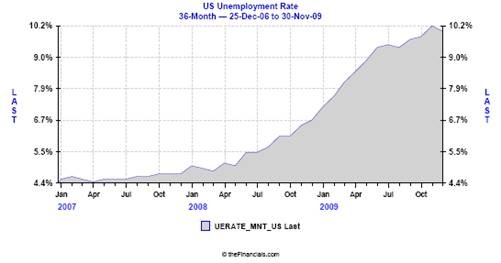
While unemployment is still at unacceptable high levels and fear of further job losses remains with many, the last three job reports have shown improvement … a needed change of direction.

clip_image008

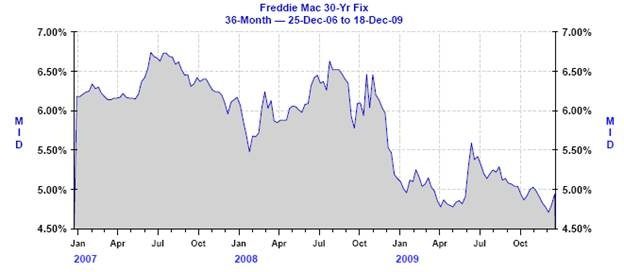
More closely related to the Real Estate Market are long term mortgage interest rates as represented by FannieMae and FreddieMac rates which remain at near 40 year historic lows. As the general economy improves these rates are predicted to rise.

clip_image010

clip_image012

The Housing Price Index (HPI) which tracks appreciation/depreciation of residential real estate market prices reflects a decline (at the national level ) of approximately 4% in market price bringing current housing affordability indexes to the most attractive level in decades.

clip_image014

But remember all Real Estate Markets are local…. And as seen below our market has fared better than most.

Median Sales Price of Existing Single-Family Homes ($000 thousands)

Metro Area      2006     2007     2008   2008.Q3  2008.Q4  2009.Q1   2009.Q2 2009.Q3 %Change
Bham AL  165.1 161.3 153.9  156.1  135.4  130.4  152.3 153.3 -1.8%
U.S.     221.9 217.9 196.6  200.4  180.2  167.3  174.2 177.9 -11.2%
NE       280.3 288.1 271.5  269.9  248.8  235.2  245.8 244.5 -9.4%
MW       164.8 161.4 150.5  158.9  139.5  131.6  146.4 150.2 -5.5%
SO       183.7 178.8 169.4  173.8  156.7  146.6  158.6 160.0 -7.9%
WE       350.5 342.5 276.1  268.0  249.3  229.2  214.2 224.0 -16.4%

Foreclosures:

Prior to 2006 foreclosures were an extremely insignificant share of total market activity and were not tracked separately by the Birmingham MLS. Effective with 2009 statistics the MLS Statistics have tracked foreclosure activity. Year-to-date foreclosures have represented approximately 25% of the real estate transactions. Even so Alabama has a favorable (as compared to other states) foreclosure rate

Local Market Data

clip_image016

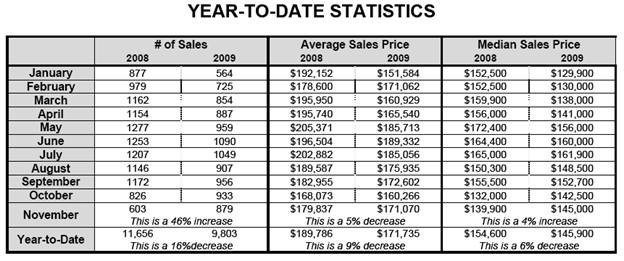
Good News: Total Birmingham area home sales increased by 46% in November 2009 compared to November 2008. Total November sales were 879 compared to 603 in November 2008.

This significant increase in total sales can be attributed to what was happening one year ago with the presidential election and the Wall Street crisis. Congress had just moved to bail out financial institutions. Home buyers became jittery by all the uncertainty and dropped out of the market in droves.

As we consider economic conditions from a year ago it is encouraging that November home sales have increased.

More Good News: The median price in the Birmingham area increased by 4 percent in November 2009 compared to November 2008. The November median price was $145,000 compared to $139,900 in November 2008.

Residential inventory continues to drop. Current levels are 26 percent lower than the highest ever recorded back in August 2007. Also note inventory is at lowest point since May 2006.

Local Inventory Levels have begun to reduce.

clip_image018

To summarize, it appears that we may have reached the bottom of the real estate market. This is further signaled by the doubling of investor transactions occurring in the third quarter. At this point improvements have been modest and it is unlikely that further improvements will be more aggressive. However, as the market does improve interest rates are likely to rise decreasing overall housing affordability. Or perhaps more succinctly: It appears 2009 was the beginning of the end of the real estate market crisis while 2010 looks to be the beginning of the recovery, albeit a slow one.

Posted in The Real Story | Leave a comment

Credit Scores – Understanding the impact of negative information on your credit report…


The Real Story…

News and commentary about the real estate market and related topics.
Dave Parrish, ABR ®, CRSA, CSP, GRI, ePRO ®, REALTOR ®, RealtySouth

Credit Scores – Understanding the impact of negative information on your credit report…

As I wrap up this series on credit, I thought it would be useful to provide a summary of the negative information that can show up on a credit report along with an explanation of its impact and longevity. These are of course in addition to a history provided by each credit provider as to the promptness and regularity of meeting your credit obligations. That is, making your payments and making them promptly.

1. Charge-offs

Missing your payments for 6 months or more could cause your creditors to deem your account as uncollectible. When this happens, the creditor writes off the account and updates your credit report as “charged-off” or “written off and uncollectible.” Charged-off accounts remain on your credit report for seven years.

2. Debt collections

Not only will creditors charge-off your account after a period of non-payment, they may also hire a third-party debt collector to attempt to collect payment from you. Your credit report may or may not be updated to reflect a collection status. Sometimes the debt collector places an entry on your credit report or the original creditor places a note on your report indicating the account is in collection status. This type activity is an obvious red flag to those considering extending credit to you.

3. Bankruptcy

Filing bankruptcy allows you to legally remove liability for some or all of your debts, depending on the type of bankruptcy you file. Your credit report will reflect each of the accounts you included in your bankruptcy. Even though the bankruptcy information will remain on your credit report for seven to 10 years, you can sometimes begin rebuilding your credit soon after your debts have been discharged.

4. Foreclosure

If you default on your mortgage loan, your lender will repossess your home and auction it off to recover the amount of the mortgage. This process is known as foreclosure. When your home is foreclosed it can severely damage your credit, limiting your ability to obtain new credit in the future. A foreclosure will remain on your credit report for seven years.

Note: Foreclosures – Deduct 200 points from your score while Pre-Foreclosure Resolutions – (Short Sale or Deed in lieu of Foreclosure) – deduct 120 points from your score. So if you had a near perfect score of say 800 and then experienced a foreclosure your credit score would fall to 600… well below the score required in today’s market to obtain a mortgage. If your financial situation  was brought about by special circumstances, such as medical expenses, you may qualify for relief sooner than the normal seven year period.

5. Tax liens

When you don’t pay property taxes on your home or another piece of property, the government can seize the property and auction it off for the unpaid taxes. Even if your home is foreclosed because of a tax lien, you are still responsible for the mortgage loan. Non-payment of the mortgage will also hurt your credit. Unpaid tax liens remain on your credit report for 15 years, while paid tax liens remain for 10.

6. Lawsuits or judgments

Some creditors may take you to court and sue you for a debt, if other collections fail. If the lawsuit is accurate and a judgment is entered against you, it will remain on your credit report for 7 years from the date of filing, even after you satisfy the judgment.

Posted in The Real Story | Tagged , , , | Leave a comment

Credit Scores – Improving Your Credit Score

The Real Story…

News and commentary about the real estate market and related topics.
Dave Parrish, ABR ®, CRSA, CSP, GRI, ePRO ®, REALTOR ®, RealtySouth

Credit Scores – Improving Your Credit Score

Let me begin with a statement of what I hope is already obvious: Responsible credit behavior and use are the keys to a good credit score and all the benefits that come with a good credit reputation, which is after all what a credit report is … your reputation as to how well you handle your credit obligations. Having said that, I also know that bad things do happen to good people and it is for those that I offer these credit repair recommendations.

As we’ve discussed over the course of the past several weeks, your credit score can be either a wonderful asset or a huge liability… So I recommended that you check your credit report/file at least once every twelve months (just in case you missed those instructions reference the November 24th post Guarding & Protecting Your Credit Score… to review its content as to how to make inquiries into your credit and discover possible errors.

So you’ve done that and you just discovered errors on your credit report, or even worse, accurate references to late payments or other debt-related issues. Take a few deep breaths and try to stay calm, because the errors can be fixed. It’s even possible that some of the negative items can be eliminated too — and without help from companies that promise to repair your credit.

Don’t let anyone fool you into thinking you need to hire a professional to repair your credit. The truth is, there is nothing a credit repair company can do to improve your credit that you can’t do for yourself. So, save yourself some money and the hassle of finding a reputable company and repair your credit yourself.

Negative Entries

Bankruptcies remain on your credit report for up to ten years, while other types of entries are generally reported for seven years. If an account that was previously past due has been brought current, and has been either paid off or kept current for at least a year, the creditor might agree to an early deletion of the past due references. Write a letter to your creditor and request that the negative entries be removed. They’ll often comply if they see you are up to date and handling your account in a positive way.

Another tactic you can use to clean up your credit report is to dispute a negative item even if you believe it is accurate, but you’ll have to follow your conscience to decide if that’s an ethical way to go.

If Changes Aren’t Made

If the credit reporting agency says the original information is accurate, it must provide you with a written notice that includes the name, address, and phone number of the person who made the report. If you still disagree, initiate a second investigation.

Unfortunately, in the real world the reporting agencies often try to sidestep that requirement, giving you standard, computer-generated information rather than the facts you need to find the person or department who made the negative report. Keep plugging away until you have the answer you’re looking for. If your attempts to correct an entry are unsuccessful, you can ask the reporting agency to insert a 100-character explanation next to it that explains your side of the story.

Posted in The Real Story | Tagged , , , | Leave a comment

Credit Scores – How to Dispute Errors


The Real Story…

News and commentary about the real estate market and related topics.
Dave Parrish, ABR ®, CRSA, CSP, GRI, ePRO ®, REALTOR ®, RealtySouth

Credit Scores – How to Dispute Credit Report Errors

As we’ve discussed over the course of the past several weeks, your credit score can be either a wonderful asset or a huge liability… So I recommended that you check your credit report/file at least once every twelve months. Just in case you missed those instructions, reference my post of Nov 24th Guarding & Protecting Your Credit Score… to review its content on how to make inquiries into your credit and possible errors. That’s right there could well be errors in your credit report that are costing you dearly.

Under the FCRA (Fair Credit Reporting Act), both the consumer reporting company and the information provider (that is, the person, company, or organization that provides information about you to a consumer reporting company) are responsible for correcting inaccurate or incomplete information in your report.

But it up to you to spot and report these errors! To take advantage of all your rights under this law, contact the consumer reporting company and the information provider.

Step One

Tell the consumer reporting company, in writing, what information you think is inaccurate. Include copies (NOT originals) of documents that support your position. In addition to providing your complete name and address, your letter should clearly identify each item in your report you dispute, state the facts and explain why you dispute the information, and request that it be removed or corrected. You may want to enclose a copy of your report with the items in question circled. Send your letter by certified mail, “return receipt requested,” so you can document what the consumer reporting company received. Keep copies of your dispute letter and enclosures.

Consumer reporting companies must investigate the items in question — usually within 30 days — unless they consider your dispute frivolous. They also must forward all the relevant data you provide about the inaccuracy to the organization that provided the information. After the information provider receives notice of a dispute from the consumer reporting company, it must investigate, review the relevant information, and report the results back to the consumer reporting company. If the information provider finds the disputed information is inaccurate, it must notify all three nationwide consumer reporting companies so they can correct the information in your file.

When the investigation is complete, the consumer reporting company must give you the results in writing and a free copy of your report if the dispute results in a change. This free report does not count as your annual free report. If an item is changed or deleted, the consumer reporting company cannot put the disputed information back in your file unless the information provider verifies that it is accurate and complete. The consumer reporting company also must send you written notice that includes the name, address, and phone number of the information provider.

If you ask, the consumer reporting company must send notices of any corrections to anyone who received your report in the past six months. You can have a corrected copy of your report sent to anyone who received a copy during the past two years for employment purposes.

If an investigation doesn’t resolve your dispute with the consumer reporting company, you can ask that a statement of the dispute be included in your file and in future reports. You also can ask the consumer reporting company to provide your statement to anyone who received a copy of your report in the recent past. You can expect to pay a fee for this service.

Step Two

Tell the creditor or other information provider (not the reporting agency but the person/entity providing the incorrect information), in writing, that you dispute an item. Be sure to include copies (NOT originals) of documents that support your position. Many providers specify an address for disputes. If the provider reports the item to a consumer reporting company, it must include a notice of your dispute. And if you are correct — that is, if the information is found to be inaccurate — the information provider may not report it again.

For more information, see Building a Better Credit Report at ftc.gov/credit

While I plan on continuing this discussion on credit scores in coming weeks to look at some ways to improve your credit scores. I will change course a bit next week to discuss the status the current market before continuing our discussion on credit scores.

Posted in The Real Story | Tagged , , , | Leave a comment

Guarding & Protecting Your Credit Score…

The Real Story…

News and commentary about the real estate market and related topics.
Dave Parrish, ABR ®, CRSA, CSP, GRI, ePRO ®, REALTOR ®, RealtySouth

Guarding & Protecting Your Credit Score…

Over the course of the last several weeks, I’ve reviewed the importance and impact of credit scores and how they are determined.

This week I’ll focus on what everyone should be doing to protect this valuable asset… A Good Credit Score.

The first step that you must take to guard your credit scores is awareness of what they are …

So begin with getting and reviewing a copy of your credit report at least once every twelve months.

A credit file disclosure, commonly called a credit report, provides you with all of the information in your credit file maintained by a consumer reporting company that could be provided by the consumer reporting company in a consumer report about you to a third party, such as a lender.

A credit file disclosure also includes a record of everyone who has received a consumer report about you from the consumer reporting company within a certain period of time (“inquiries”).

The credit file disclosure includes certain information that is not included in a consumer report about you to a third party, such as the inquiries of companies for pre-approved offers of credit or insurance and account reviews, and any medical account information which is suppressed for third party users of consumer reports.

You are entitled to receive a disclosure copy of your credit file from a consumer reporting company under Federal law and the laws of various states. The Fair Credit Reporting Act (FCRA) requires each of the nationwide consumer reporting companies — Equifax, Experian, and TransUnion — to provide you with a FREE copy of your credit report, at your request, once every 12 months. This free report is not automatic… You must request the report using the procedure described below.

The three nationwide consumer reporting companies have set up a central website, a toll-free telephone number, and a mailing address through which you can order your free annual report.

To order, visit annualcreditreport.com, call 1-877-322-8228, or complete the Annual Credit Report Request Form and mail it to:

Annual Credit Report Request Service
P.O. Box 105281
Atlanta, GA 30348-5281

For a copy of the form use the following link:

http://www.ftc.gov/bcp/edu/resources/forms/requestformfinal.pdf

Do not contact the three nationwide consumer reporting companies directly, as they only provide free annual credit reports through one of the channels noted above.

You may order your reports from each of the three nationwide consumer reporting companies at the same time, or you can order your report from each of the companies one at a time. The law allows you to order one free copy of your report from each of the nationwide consumer reporting companies every 12 months.

A Warning About “Imposter” Websites

Only one website is authorized to fill orders for the free annual credit report you are entitled to under law — annualcreditreport.com. Other websites that claim to offer “free credit reports,” “free credit scores,” or “free credit monitoring” are not part of the legally mandated free annual credit report program. In some cases, the “free” product comes with strings attached. For example, some sites sign you up for a supposedly “free” service that converts to one you have to pay for after a trial period. If you don’t cancel during the trial period, you may be unwittingly agreeing to let the company start charging fees to your credit card.

Some “imposter” sites use terms like “free report” in their names; others have URLs that purposely misspell annualcreditreport.com in the hope that you will mistype the name of the official site. Some of these “imposter” sites direct you to other sites that try to sell you something or collect your personal information.

Annualcreditreport.com and the nationwide consumer reporting companies will not send you an email asking for your personal information. If you get an email, see a pop-up ad, or get a phone call from someone claiming to be from annualcreditreport.com or any of the three nationwide consumer reporting companies, do not reply or click on any link in the message. It’s probably a scam. Forward any such email to the FTC at spam@uce.gov.

Next week I’ll discuss what to do if you see errors on your credit report.

Posted in The Real Story | Tagged , , | Leave a comment

How Your Credit Score Is Determined

Technorati Tags: ,,

The Real Story…

News and commentary about the real estate market and related topics.
Dave Parrish, ABR ®, CRSA, CSP, GRI, ePRO ®, REALTOR ®, RealtySouth

How Your Credit Score Is Determined

As we have previously discussed, your credit score (FICO Score) has far reaching impact on your life and your cost of living including possible impact on employment opportunities. With this in mind I thought it would be useful to discuss how your credit score is determined.

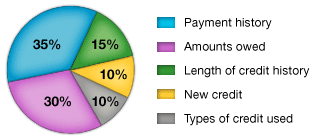
Your credit score is determined by a variety of factors, each of which makes up a portion of the score:

 clip_image002

Note that the exact formula for calculating credit scores is constantly being evaluated and is subject to modification. The percentages indicated here are for comparative purposes only and are not meant to represent any precise scoring formula.

By far the most important factor in determining your credit score is your individual payment history. Previous loans and the ability to pay them are shown in this portion of the score. Both late payments and failure to pay at all affect this portion of the score. Those who have paid all of his or her loans on time will obtain the highest scores.

Secondly your score is determined by current debts, and the ratio of debt to the amount of available credit. Keeping all of your credit cards at or near their limits will hurt this portion of your score. The obvious assumption being: if you are already near your credit limit, you may have trouble paying back any future loans.

The remaining portion of your credit score is determined by three factors – length of credit history, recent credit applications, and the types of overall credit in the individual’s credit history. The length of the credit history is the most significant of these, as lenders are more suspicious of borrowers who have not established a pattern of borrowing and repaying loans. A history of repaid loans goes a long way towards strengthening this portion of the score. Recent credit applications, particularly a lot of them, may suggest that the individual is desperate to borrow more money and may have a financial problem. Similarly, the types of credit demonstrate spending patterns and reliability. A credit report containing all credit cards may be seen as more risky than one with a few credit cards, a repaid auto loan and an ongoing mortgage.

By seeing how your credit score is determined, you can take action to keep your scores healthy. A good score helps you obtain loans at better interest rates, and that is something that everyone can appreciate.

Your score considers both positive and negative information in your credit report. Late payments will lower your score, but establishing or re-establishing a good track record of making payments on time will raise your credit score.

While credit scores are only determined from the information in your credit report, lenders look at many things when making a credit decision including your income, how long you have worked at your present job and the kind of credit you are requesting.

In future articles we will look at what you can do to protect and improve your credit score.

Posted in The Real Story | Tagged , , | Leave a comment

Tax Credit for Home Buyers is Extended and Expanded…


The Real Story …

News and commentary about the real estate market and related topics.
Dave Parrish, ABR ®, CRSA, CSP, GRI, ePRO ®, REALTOR ®, RealtySouth

Tax Credit for Home Buyers is Extended and Expanded

We interrupt our regularly scheduled programming… I had planned on discussing additional credit score topics as a continuation of last week’s column … However, this bit of hot news must come first!

President Obama just signed the Homebuyer Tax Credit Extension, making the $8,000 tax credit available through April 30, 2010. As part of an economic stimulus package, the tax credit that’s been available this year to first-time homebuyers will be extended, but a new addition to the package is now being offered to current homeowners. For those who have lived in their home for 5 or more years, a $6,500 tax credit is now available. Income limits have been raised as well, from $75,000 for a single homeowner to $125,000 and $125,000 for a couple to $225,000.Wednesday evening, the Senate passed this bill unanimously and Thursday evening, the House of Representatives voted 403 to 12 in favor of the stimulus plan.


The following details apply to the homebuyer tax credit expansion:

Who is Eligible

· First-time homebuyers, who are defined by the law as buyers who have not owned a principal residence during the three-year period prior to the purchase, may be eligible for up to an $8,000 tax credit.

· Existing home owners who have been residing in their principal residence for five consecutive years out of the last eight and are purchasing a home to be their principal residence (“repeat buyer”), may be eligible for up to a $6,500 tax credit.

· All U.S. citizens who file taxes are eligible to participate in the program.

Income Limits
Homebuyers who file as single or head-of-household taxpayers can claim the full credit ($8,000 for first-time buyers and $6,500 for repeat buyers) if their modified adjusted gross income (MAGI) is less than $125,000.

For married couples filing a joint return, the combined income limit is $225,000.

Single or head-of-household taxpayers who earn between $125,000 and $145,000, and married couples who earn between $225,000 and $245,000 are eligible to receive a partial credit.

The credit is not available for single taxpayers whose MAGI (Modified Adjusted Gross Income) is greater than $145,000 and married couples with a MAGI that exceeds $245,000.

Effective Dates
The eligibility period for the tax credit is for homes purchased after Nov. 6, 2009, and before May 1, 2010. However, home purchases subject to a binding sales contract signed by April 30, 2010, will qualify for the tax credit provided closing occurs prior to July 1, 2010.

Types of Homes that Qualify
All homes with a purchase price of less than $800,000 qualify, including newly-constructed or resale, and single-family detached, townhomes or condominiums, provided that the home will be used as their principal residence.

Vacation home and rental property purchases do NOT qualify.

Tax Credit is Refundable

A refundable credit means that if the amount of income taxes you owe is less than the credit amount you qualify for, the government will send you a check for the difference. All qualified homebuyers can take the tax credit on their 2009 or 2010 income tax return.

Payback Provisions

The tax credit is a true credit. It does not have to be repaid unless the home owner sells or stops using the home as their principal residence within three years after the purchase.

The www.federalhousingtaxcredit.com site has been updated. Check the site for more detailed information on the new tax credit.

Economic Impact… The extension of this credit is also great news for anyone in the market to sell their home as it does create strong incentives to purchasers. It’s also good news for the economy as new home construction, which is sure to be impacted, is a large contributor to the jobs market. New home purchases also contribute significantly to the retail market as sellers get homes ready to sell and buyers dress up and personalize that new home.

Posted in The Real Story | Tagged , , , , | Leave a comment